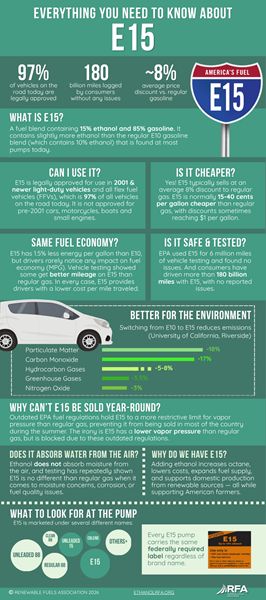
E15 is a fuel blend containing 15% ethanol and 85% gasoline. It contains slightly more ethanol than the regular E10 gasoline blend (which contains 10% ethanol) that is ubiquitous in the market today. View our Infographic to learn more about E15. View our E15 Fact Sheet on the right regarding misconceptions about the year-round use of this lower-cost, lower-carbon fuel.
The U.S. Environmental Protection Agency (EPA) legally approved E15 in 2011, and it was first sold at a retail station in Kansas in 2012. It has been in the marketplace since then, and we estimate more than 8 billion gallons of E15 have been sold. That means consumers have driven more than 180 billion miles on E15 since 2012 without any legitimate reports of performance issues or engine problems.
Everything You Need to Know about E15
E15 is fully approved for use in cars, SUVs, pickups, vans, and other light-duty vehicles manufactured after the year 2000. That means more than 97% of the vehicles on the road today are legally approved to use E15. If you do not know what year your vehicle was made, check your owner’s manual or the sticker on the driver’s side door jamb.
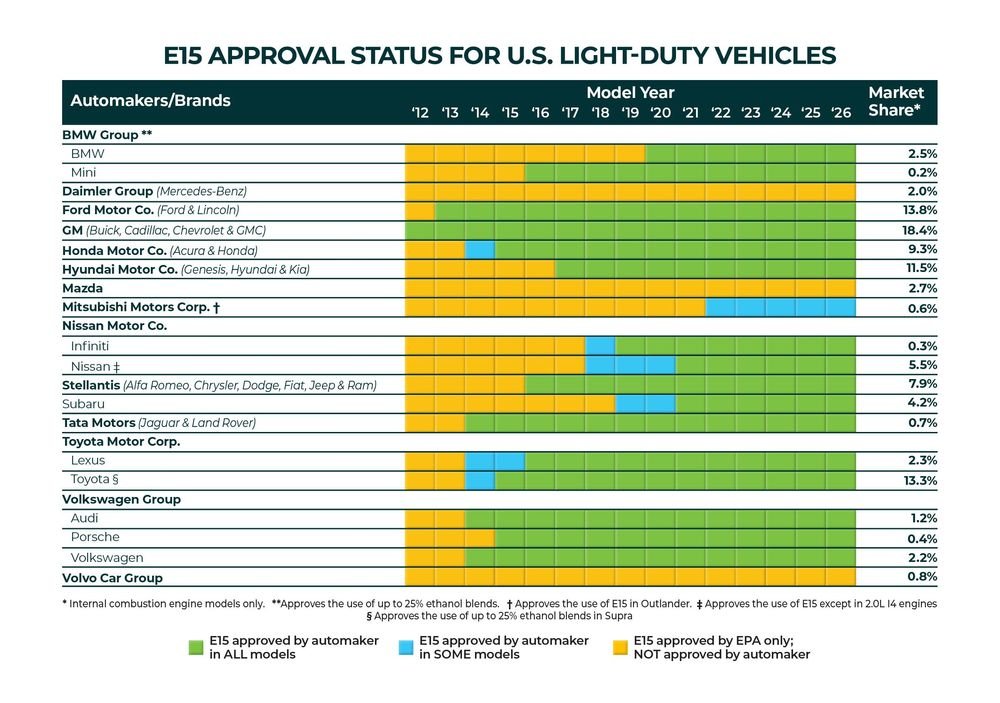
Yes, the overwhelming majority of automakers explicity approve the use of E15 in modern vehicles. For example, roughly 95% of the model year 2020-2026 vehicles sold carry the manufacturer's unequivocal approval to use E15.
E15 is the most thoroughly tested fuel in history. Before approving the fuel in 2011, EPA and the U.S. Department of Energy rigorously tested the use of E15 in 80 vehicles, accumulating more than 6 million miles while operating on the fuel. Scientists carefully analyzed the impact of E15 on drivability, catalyst durability, fuel pumps, seals, diagnostic systems, fuel system components, fuel economy, and exhaust emissions. They definitively concluded that E15 is safe for use in all vehicles built after 2000.
E15 is available today at more than 4,800 retail stations in 36 states. To find a station near you, visit this web site and click the “Show E15” button below the map, then zoom in on your area. E15 is available at half the gas stations in Iowa, one in 5 in Minnesota, and one out of every 10 stations in Nebraska and Wisconsin. It is also commonly available in states like Florida, Ohio, North Carolina, Pennsylvania, Texas, Virginia, and West Virginia. E15 is offered by leading retail chains like Sheetz, Casey’s, Kwik Trip/Kwik Star, Maverik, RaceTrac, Family Express, Cenex, Royal Farms, and others. If E15 isn’t offered near you today, encourage your local retail station to begin selling the fuel. For most retailers, making the switch to E15 is quick and does not cost much.
Yes, retail stations that sell E15 often give the fuel a marketing name like Unleaded 88, Regular 88, Clean 88, eBlend, Unleaded15, and others. But regardless of what it is called, every pump offering E15 will have the same federally required label affixed to the pump (usually near the hose and nozzle that dispense the fuel). It is important to note that E15 is offered at various octane levels.
In most cases, E15 offers slightly higher octane (88 AKI) than regular E10 gasoline (87 AKI). That’s why many retailers choose to include “88” in the marketing names they give to E15. The higher octane rating means E15 offers greater horsepower and increased combustion efficiency (i.e., resistance to premature fuel ignition). Be aware, however, that E15 is not offered at 88 octane in every case. While 88 octane is most common, E15 has also been sold at 86, 87, 89, 91 and even 94 octane.
How much will E15 cost me?
In recent years, E15 has typically sold at a 10-40 cent per gallon discount to regular gasoline that contains 10% ethanol. In some cases, the discount has been as much as 60-80 cents per gallon. E15’s price is often 5-10% lower than the price for E10 (and 13-17% below the price of E0). Each day, drivers report E15 and E85 prices from their local stations on this web site. Click the red “Show E15” button under the map to see the latest reported E15 prices.
Using ethanol helps lower gasoline prices by ensuring options at the pump and expanding gasoline supplies, which improves our energy independence by lowering imports of expensive, petroleum-based gasoline components or more crude oil from unstable parts of the world like the Middle East. Use our Ethanol Savings Calculator to find out how much you can save by fueling up with E15.
While a gallon of E15 contains 1.5% less energy than a gallon of regular gasoline (E10), drivers rarely notice any impact on fuel economy (miles per gallon). If fuel economy was perfectly correlated with energy density, then a vehicle that gets 30 miles per gallon when operating on regular gasoline would be expected to get 29.6 miles per gallon when operating on E15. However, many variables can impact fuel economy in the real world, and a recent study conducted by the University of California showed some vehicles experienced slightly better fuel economy when using E15 instead of E10. Also, even if fuel economy dropped by 1.5% when operating on E15, the fuel is typically sold at a 5-10% discount to E10. That means E15 would still provide a lower cost per mile traveled.
Because ethanol is a renewable fuel that burns cleaner and reduces carbon, the use of E15 results in lower emissions than regular E10 gasoline. Using E15 in place of E10 reduces greenhouse gas emissions by about 3%, while also reducing pollutants that cause ground-level ozone and smog. By displacing hydrocarbon substances like aromatics in gasoline, ethanol significantly reduces emissions of air toxics, particulate matter, carbon monoxide, nitrous oxides, and exhaust hydrocarbons. You can read more about ethanol’s impact on the environment here.
No, E15 is not approved by EPA for use in motorcycles, boats, snowmobiles, lawnmowers, chainsaws, and other non-road equipment. However, E10, which is available at virtually every gas station in the country today, is generally approved for use in this equipment and ethanol-free gasoline (E0) remains broadly available for those consumers who wish to use it. Drivers should note, however, that E0 is the most expensive and highest-emitting grade of gasoline sold today.
E15 Improves America’s Energy Independence
Increased ethanol production continues to help diversify our nation’s fuel supply and dampen the impacts of petroleum market shocks. The more American-made ethanol use, the more energy independent we are. You can read more about how ethanol helps reduce our dependence on foreign oil here.