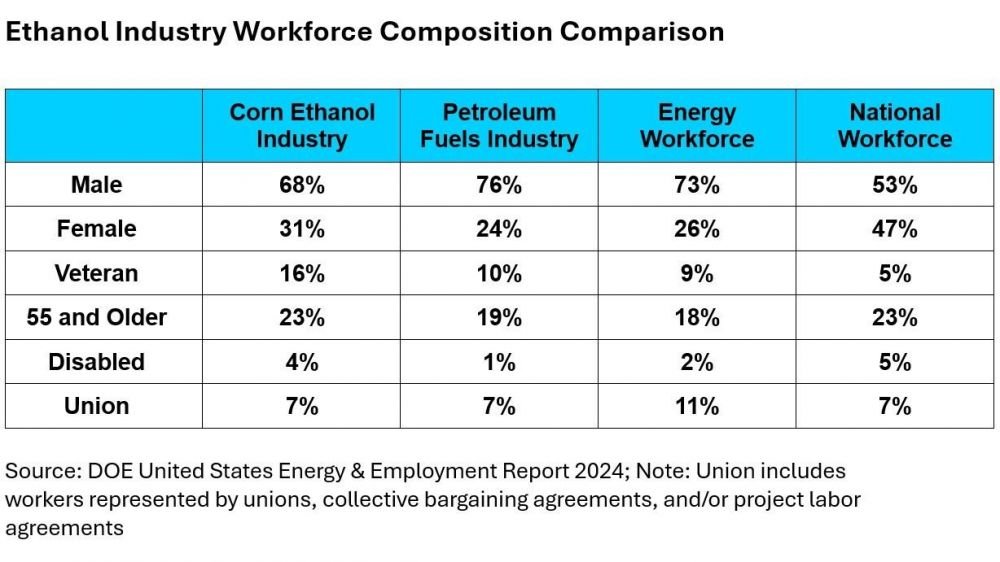
The U.S. corn ethanol industry continues to stand out for its employment of military veterans, according to the United States Energy & Employment Report released Wednesday by the U.S. Department of Energy (DOE). Veterans make up 16 percent of the ethanol industry workforce, which is three times the national private sector workforce average and 60 percent higher than in the petroleum fuels industry.
Additionally, compared to the energy sector overall, the ethanol industry is notable for its employment of women and workers over 55 years old. Women represent 31 percent of the ethanol industry workforce, compared to 24 percent for the petroleum fuels industry and 26 percent for the overall energy sector. Nearly a quarter of the industry’s workforce is 55 or older, versus 19 percent for petroleum fuels and 18 percent for the energy sector.
“The ethanol industry continues to offer good-paying jobs across rural America, and I am particularly proud of the industry’s longstanding record of employing thousands of military veterans,” said Renewable Fuels Association President and CEO Geoff Cooper, an Army veteran. “Ethanol is an American-made fuel that bolsters our national energy security and reduces dependency on foreign energy sources, making the industry a natural fit for women and men who have served our country in uniform.”
Reflecting the ethanol industry’s commitment to supporting military service, 20 percent of RFA’s staff members have served in the armed forces. The Department of Defense recognized RFA with its Patriotic Employer award in April for “contributing to national security and protecting liberty and freedom by supporting employee participation in America’s national guard and reserve force.”
The DOE also estimated that workers with disabilities comprise 4 percent of the ethanol industry workforce, which is at least double the average in the petroleum fuels industry and the overall energy sector and is close to the national average. Meanwhile, 7 percent of ethanol industry workers belong to a union or are otherwise covered by a labor agreement, which is on par with the nationwide energy sector and the private sector workforce average.
The report addresses only direct employment by companies in the energy sector, rather than employment by suppliers or jobs supported by income generated by the sector. This is notable, since a significant share of the ethanol industry’s indirect employment and its economic impact occurs in the agriculture sector, a contribution that is especially important at a time when corn prices are hitting multiyear lows.