Earlier today, the R Street Institute—a self-described “think tank whose work is grounded in liberty and freedom”—published an opinion piece (heavy emphasis on “opinion”) on ethanol policy. It’s a real doozy, chock full of myths and misinformation and the same old lies that have been pushed by the anti-ethanol crowd for decades. Typically, we’d ignore this sort of fear-mongering pablum, but given the increased focus on ethanol and E15 these days, RFA felt it was necessary to pull out the red pen and do some good, old-fashioned fact-checking on the R Street Institute. For an entity that claims to support “free markets and limited, effective government,” they sure seem threatened by the competition, consumer choice, and economic freedom that deregulatory action allowing year-round, nationwide access to E15 would provide.
R Street Institute Claim
RFA Red Pen
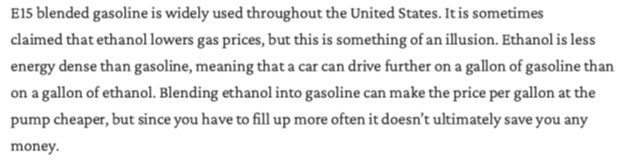
E15’s lower price is “something of an illusion”? What? R Street Institute is telling consumers not to believe their own eyes. E15 costs less at the pump than regular E10 gasoline. Period. That isn’t a “claim,” it’s a fact. In recent months, the savings have averaged 20-40 cents per gallon—sometimes even more! Today, E15 is priced 7-10% below regular E10 on average.
E15 is just 1.7% less energy dense than regular gasoline, and lab testing of 20 vehicles shows the average fuel economy difference (miles per gallon) was just 1% when using E15 instead of E10. But what really matters is the cost per mile travelled. E15’s lower cost at the pump overwhelms the negligible reduction in fuel economy, meaning drivers spend less money to travel the same distance.
And do you really need to “fill up more often” with E15? NO. The difference in fuel economy is so small that in the worst-case scenario, a typical American household might need to make just one extra trip to the gas station during the course of a whole year!
R Street Institute Claim
RFA Red Pen
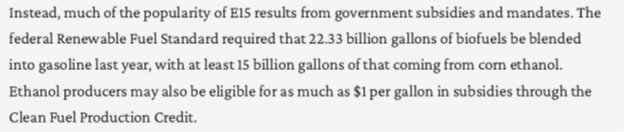
Actually, the RFS requires fuel refiners and importers to blend 26.8 billion gallons of renewable fuel into gasoline and diesel this year. That’s a good thing. And guess what? There is NO requirement that any amount of that renewable fuel—15 billion gallons or otherwise—must come from corn ethanol! Refiners and importers choose to use ethanol to meet RFS requirements because it is the lowest-cost option and helps them meet octane standards and fuel quality requirements.
What’s more. the Clean Fuel Production Credit (otherwise known as “45Z”) is NOT an “ethanol subsidy.” The tax incentive is available to ANY producer of ANY fuel that meets certain criteria related to the carbon intensity of the fuel they produce.
R Street Institute Claim
RFA Red Pen
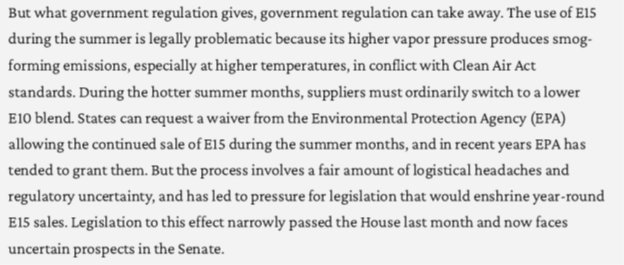
Wow! Really?! Do your research! E15 has LOWER vapor pressure than standard E10 gasoline. And according to experts at UC Riverside, DOE, and other institutions, E15 has LOWER smog-forming potential. The problem is: a 35-year-old regulation holds E15 to a more restrictive vapor pressure limit than regular gasoline (because that regulation was developed decades before E15 was even a consideration). The legislation making its way through Congress now would simply apply the SAME vapor pressure limit to all grades of gasoline. We thought R Street Institute supported deregulation, removing red tape, and giving consumers a choice…guess not!
R Street Institute Claim
RFA Red Pen
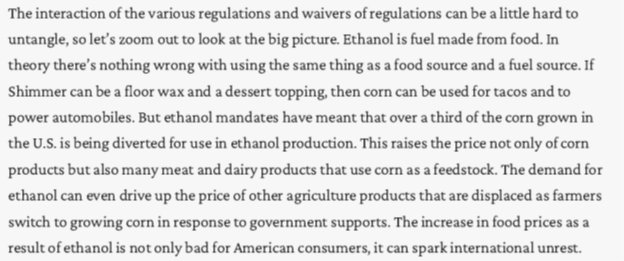
Here it is…the old “food versus fuel” myth. Shocking! Ethanol is NOT made from food. Have you ever tried to eat the corn that is used to make ethanol!? Hope you have a good dental plan! Ethanol is made from field corn—the type that is used for livestock feed—NOT sweet corn or the food-grade white and yellow corn grown for tortilla chips and taco shells.
Corn is not being “diverted” away from other uses, like livestock feed. The fact is, farmers are growing more than enough corn to meet all demands on the same amount of land—or less—than in the past. And ethanol plants only use the starch portion of the corn kernel. The protein and much of the fat, fiber, and other nutrients are returned to the feed market in the form of “distillers grains”—a lower-cost, higher-nutrition animal feed product.
And in case you hadn’t noticed, corn prices are DOWN. Even with record ethanol production last year, corn prices averaged just $4.15 per bushel. That’s $2.39 lower (37%) than the average corn price in 2022/23 and well below the 15-year average price. And since everyone is talking about inflation these days, the inflation-adjusted price of corn is at its lowest point since 1910, according to USDA.
“International unrest”?! Hardly. The truth is countries around the world (from India to Japan and Canada to Colombia) are adopting policies to greatly increase their use of lower-cost, lower-carbon ethanol—for the very same reasons we are expanding renewable fuels in the U.S.
R Street Institute Claim
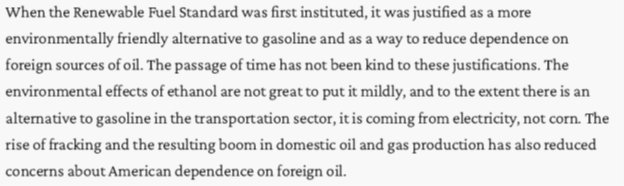
RFA Red Pen
The proof is in the pudding. The RFS has undeniably lived up to—and even surpassed—its original policy objectives. Increased renewable fuel use under the RFS has reduced emissions, lowered gas prices, and substantially reduced the need for crude oil and petroleum product imports.
Experts from the DOE, Treasury Department, USDA, and leading universities (including Harvard, MIT, Purdue, University of Illinois, and others) have all confirmed that ethanol meaningfully reduces GHG emissions compared to petroleum. Others (like UC Riverside and the University of Minnesota/Hormel Institute) have demonstrated that higher ethanol blends like E15 reduce tailpipe emissions of pollutants that lead to smog formation and human health problems like cancer.
To promote electricity as the “silver bullet” solution for transportation is not just tone deaf, but utterly dishonest (experts are expressing growing concern about surging electricity prices, “America’s power shortage,” and a “reliability crisis” in electricity markets, while consumers are expressing “electricity rage.”)
And to suggest Americans are no longer concerned about “American dependence on foreign oil” shows that R Street is completely untethered from reality. Take a look around! War in the Middle East and oil shipping disruptions in the Strait of Hormuz have created a global energy crisis, near-record high pump prices, and the lowest U.S. seasonal petroleum stocks in 30 years, while draining the strategic petroleum reserve to its lowest level since 1983!
Pull your head out of the sand. Now—more than ever—we need more diverse, more secure domestic energy sources. We need more ethanol!